
Diagnostic instrumentation · Polymer optics · 2026-10-20
Optical mold insert for a diagnostic cartridge
A lens surface and optical window in a cartridge replication insert: a focused trial connecting geometry, light collection and manufacturing feedback.
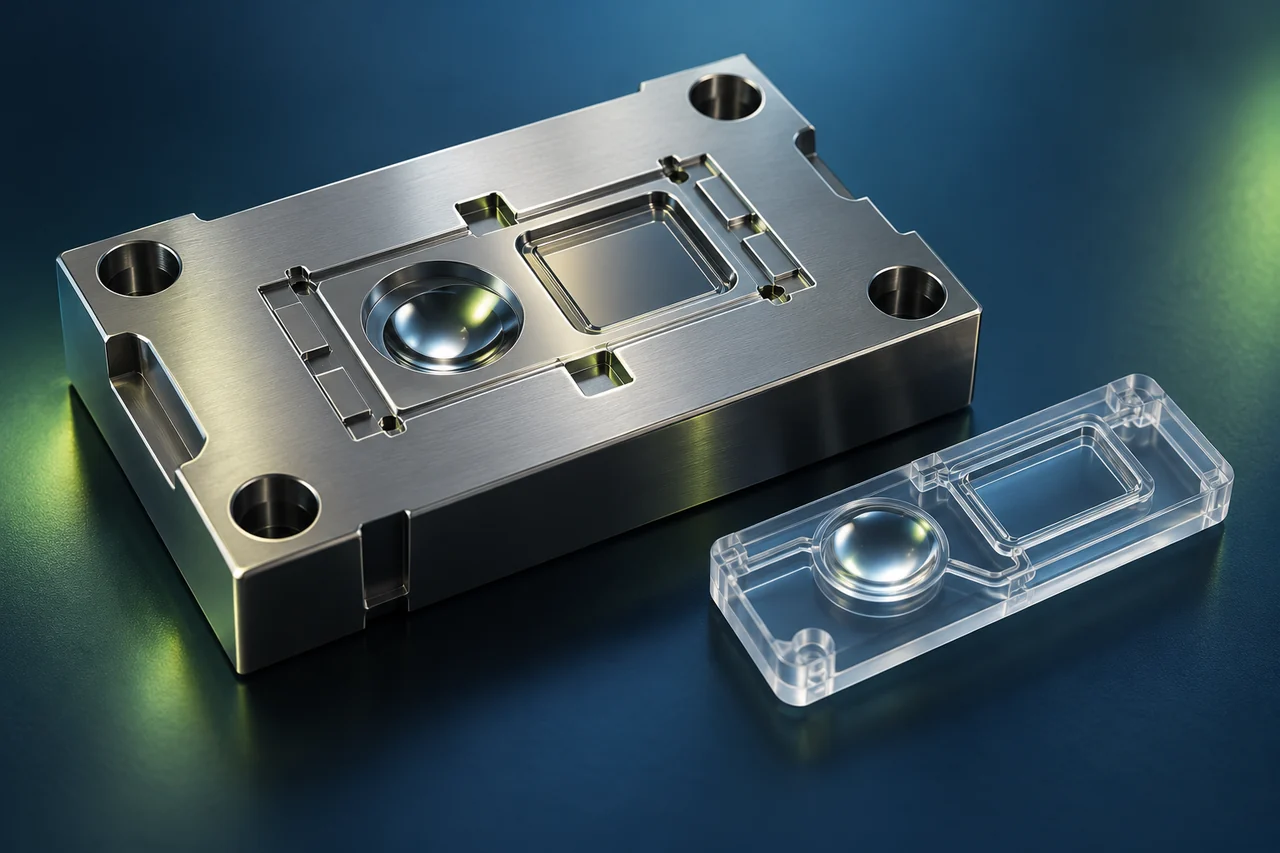
AI-generated engineering concept · Not to scale; not a manufactured component or measurement result.
FROM CONCEPT TO YOUR COMPONENT
Start with the function, material and the question your first trial should answer.
Why work with us? Learn from an optical trial insert before committing to the full cartridge.
The zone critical to optical readout
We can focus IL600 machining on the cartridge's lens and window surfaces and their relative positions. The first deliverable can therefore be the insert critical to optical coupling rather than the entire microfluidic product.
A separately scoped development stage
A trial insert and assessment of the partner's replica can form a separate work package. This allows the readout concept to be assessed before deciding on full production tooling.
Clear boundaries for technical delivery
We align geometric documentation with replication and optical trials. Machining alone does not establish diagnostic sensitivity, biocompatibility or clinical compliance; the required tests are planned separately.
The optical task between sample volume and detector
For fluorescence readout or other optical cartridge measurements, the relative positions of lens surface, window and mechanical interface matter. The proposed concept addresses insert surfaces defining the light path. Biological reactions, fluidic operation and the evaluation algorithm remain with the system developer.
Connecting optical surface and insert geometry
On the IL600, finishing an aspheric cavity and producing related datum surfaces can follow one process plan. Substrate and any nickel-phosphorus layer are selected around replication temperature, polymer and intended service life. Edges, transition zones and access to the optical window can be critical too.
Three separate evaluations: insert, replica and readout
Insert evaluation covers form, topography and relative surface positions. Shrinkage, warpage and residual stress in the first polymer replica are assessed with the molding partner. Signal-to-background ratio and optical readout performance belong to the system's own validation plan.
First step: a trial insert for the critical optical region
Before a complete production mold, a trial insert can isolate the most important lens and window features. Machining evaluation is combined with feedback from the system developer and replication partner. This first trial addresses geometric transfer and optical integration, rather than claiming a clinical outcome.
Does this concept imply medical-device certification?
No. This is an optical component and tooling development concept. The responsible manufacturer must establish final-product conformity, biocompatibility, sterilisation suitability and clinical usability. The first brief needs polymer, wavelength, active region, optical model, replication process and agreed inspection responsibilities.
For the next discussion
We scope this development route around your application.
The application behind the component.
Review the operating requirements and related engineering tasks in these application areas.
CONNECTED ENGINEERING
Different challenges. Different geometries. Shared precision.
- 01Function
- 02Geometry
- 03Application
Conceptual illustration of our engineering approach.
THE NEXT STEP
Let’s talk about your next component.
Tell us about its function, material and critical engineering question. Together, we can define a feasibility review or a focused first trial.