
Micro-optical master · 2026-10-06
Microlens-array master
A replication master with ordered microlenses for beam-shaping and illumination development.
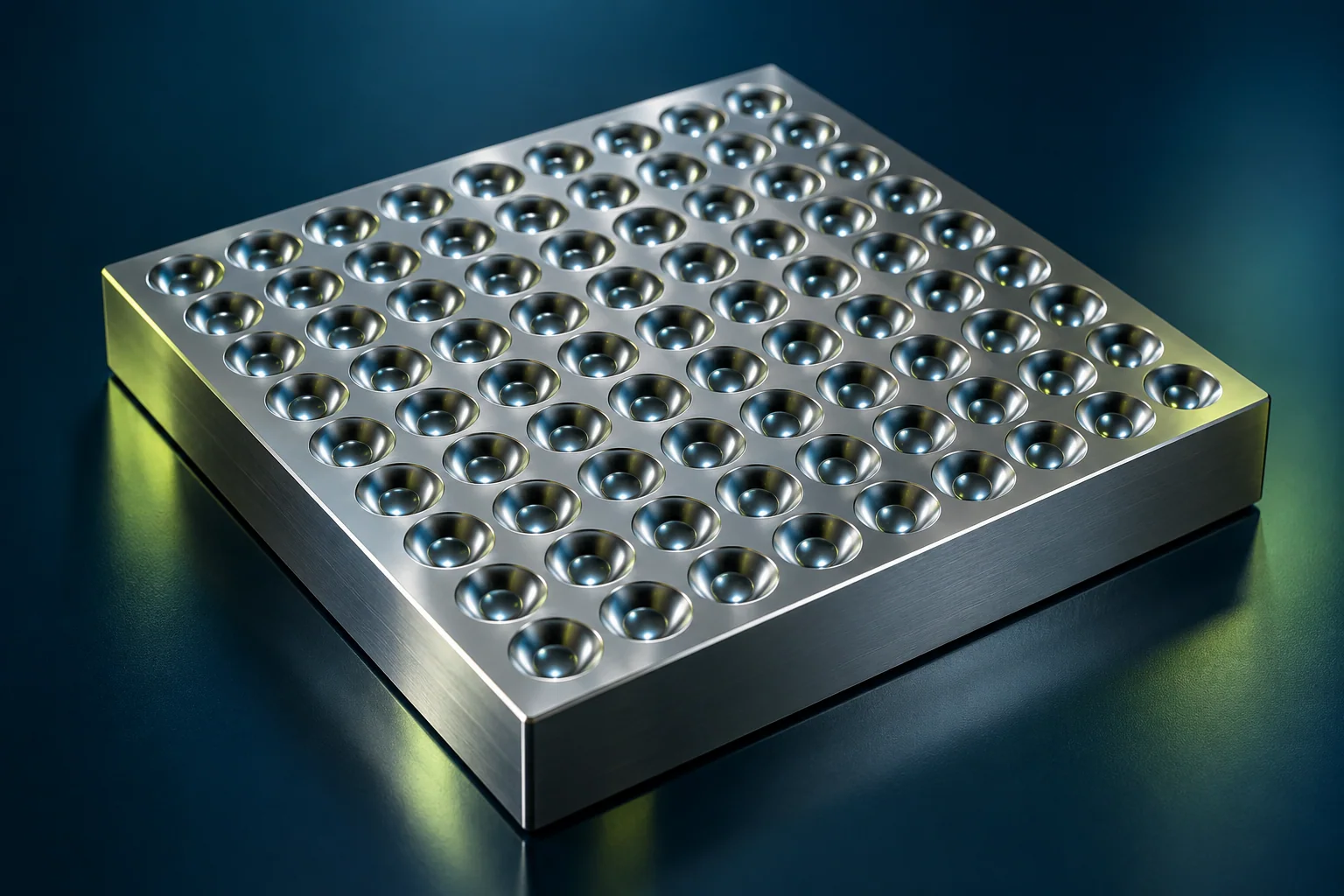
AI-generated engineering concept · Not to scale; not a manufactured component or measurement result.
FROM CONCEPT TO YOUR COMPONENT
Start with the function, material and the question your first trial should answer.
Why work with us? Test the critical lens group before the full array.
Microgeometry and layout in one plan
We prepare IL600 freeform and microstructure machining around lens profiles, pitch and transition edges. A single master allows the individual lens geometry and array layout to be assessed together.
A representative sample before the full master
The first work package can focus on the steepest or most densely packed lens group. Access and edge-formation issues may then be identified before machining the complete array.
Give the next revision a reason
We compare master geometry with feedback from the optical designer and replication partner. This is a useful starting point for a custom array; a separate master may be unnecessary when a standard micro-optic already fits.
One master, many optical elements
This concept describes a metallic master carrying an ordered set of concave lens surfaces. The objective is a replicable, explicitly defined micro-optical pattern; the final optical material and replication process form another work package. It is not an already manufactured product.
Inputs · lens profile, pitch and fill
Alongside the lens profile, define array layout, pitch, element count and active-region boundaries. Ideal intersections must be translated into manufacturable geometry using tool radius and motion requirements. The intended light distribution is agreed with the optical design model.
Trial · a representative lens group
A selected lens group can establish local form, boundary zones and tool access before the entire array is commissioned. The IL600 microstructuring route and pre-machining are selected for the material. Row and column positions are evaluated in the master’s datum system.
Evaluation · geometry and replicated performance
Inspection distinguishes individual lens form from array layout. Light distribution or uniformity of the replicated element can be assessed in the customer’s optical test. Comparing the two results informs the next revision.
an agreed trial area, geometric evaluation and a development plan for the complete master.
The application behind the component.
Review the operating requirements and related engineering tasks in these application areas.
CONNECTED ENGINEERING
Different challenges. Different geometries. Shared precision.
- 01Function
- 02Geometry
- 03Application
Conceptual illustration of our engineering approach.
THE NEXT STEP
Let’s talk about your next component.
Tell us about its function, material and critical engineering question. Together, we can define a feasibility review or a focused first trial.