
Optics and photonics
Off-axis parabolic mirror
A reflective-component concept that develops the optical surface and mounting datums together.
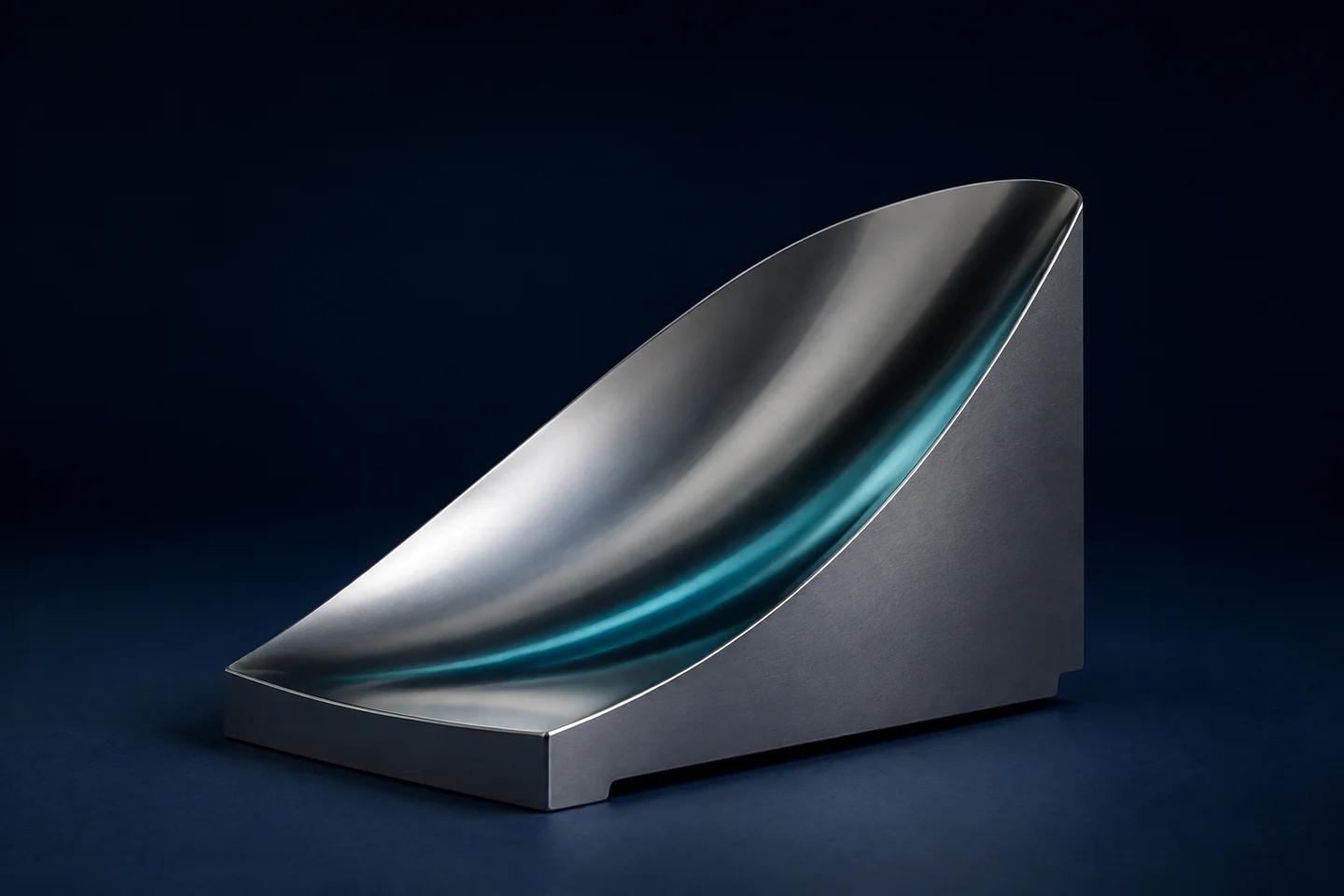
Illustrative diagram or concept image · Not a manufactured component or measurement result.
Project objective
We would investigate an off-axis parabolic mirror for a laboratory or infrared optical system. The proposed component would focus or collimate a defined beam, with geometry suited to the system layout.
The engineering challenge
The relationship between the usable mirror segment and the complete mathematical paraboloid requires an unambiguous surface definition. The mechanical drawing must show the optical surface’s position relative to the mounting datums.
Coating, assembly and thermal loading can subsequently affect performance. The development plan would therefore distinguish evaluation of the uncoated part, the final surface and the installed component.
Proposed development route
We would review the substrate, off-axis geometry, aperture and mechanical interface alongside the optical model. The manufacturing route would be built around tool access and measurability.
Geometry achievable through the IL600’s coordinated axis and tool movements would be assessed for the available material. An agreed surface evaluation would precede final coating. Coating and wavelength-dependent testing may be separately assigned tasks.
Milestones and deliverables
01 · Alignment of optical and mechanical coordinate systems.
02 · A workholding, material and machining concept.
03 · A first mirror with the agreed geometric measurement results.
04 · A plan for coating and post-installation functional testing, with responsibilities defined.
How success would be evaluated
Surface form would be assessed over the specified optical aperture, and the relationship to mounting datums in mechanical coordinates. Final system function would need to be verified at the intended wavelength and setup. A manufacturing decision depends on detailed optical requirements and measurement access.
Who this could support
Laser-instrument teams, spectroscopy and infrared-system developers, and research laboratories. An optical model or system diagram, wavelength, aperture and mounting concept would support the first discussion.
CONNECTED ENGINEERING
Different challenges. Different geometries. Shared precision.
- 01Function
- 02Geometry
- 03Application
Conceptual illustration of our engineering approach.
THE NEXT STEP
Let’s talk about your next component.
Tell us about its function, material and critical engineering question. Together, we can define a feasibility review or a focused first trial.